مشروعات تطبيقية · الدرس 4.3
لعبة الذاكرة والحساب
العودة إلى الدروستشغيل اللعبة
تجمع التجربة LCD1602 وجهاز التحكم عن بُعد (Infrared Remote Controller) ومستقبل الأشعة تحت الحمراء (Infrared Receiver Module) والطنان لتعميق فهم تطبيقاتها وتنمية التفكير البرمجي.
المكونات المطلوبة
- لوحة أردوينو (ELEGOO UNO R3) وشاشة العرض (LCD1602 Module).
- جهاز تحكم عن بُعد (Infrared Remote) ومستقبل الأشعة تحت الحمراء (Infrared Receiver Module) وطنان غير نشط (Passive Buzzer).
- لوحة توسعة لعبة الذاكرة والحساب (Memory Algorithms Game Extension).
مستويات الصعوبة
أدخل مستوى 1 أو 2 أو 3 في واجهة الاختيار:
- يظهر رقم عشوائي ويختفي بعد ثانيتين؛ تذكره وأدخله بعد اختفائه.
- تظهر مسألة جمع وتختفي بعد ثانيتين؛ احسب الناتج وأدخل الإجابة.
- تظهر مسألة ضرب وتختفي بعد ثانيتين؛ أدخل الناتج الصحيح.
بعد كتابة العدد اضغط زر التأكيد. يوجد زر لمسح آخر محرف Backspace، وآخر لإفراغ العدد. تعرض الشاشة صحة الإجابة أو خطأها، ثم النقاط عند انتهاء اللعبة.
أدر المقاومة المتغيرة (Potentiometer) لضبط تباين الشاشة. الإجابة الصحيحة تعطي ضوءًا أخضر، والخاطئة أحمر، والدرجة الكاملة ضوءًا ورديًا.
المبدأ
تعرض واجهة اختيار الصعوبة وتستقبل IR، ثم تلتقط المفتاح لتحديد المستوى أو إظهار خطأ. يتابع البرنامج عرض المسألة واستقبال الإجابة والتحقق منها وحساب النقاط. لمزيد من التفاصيل راجع تعليقات الكود.
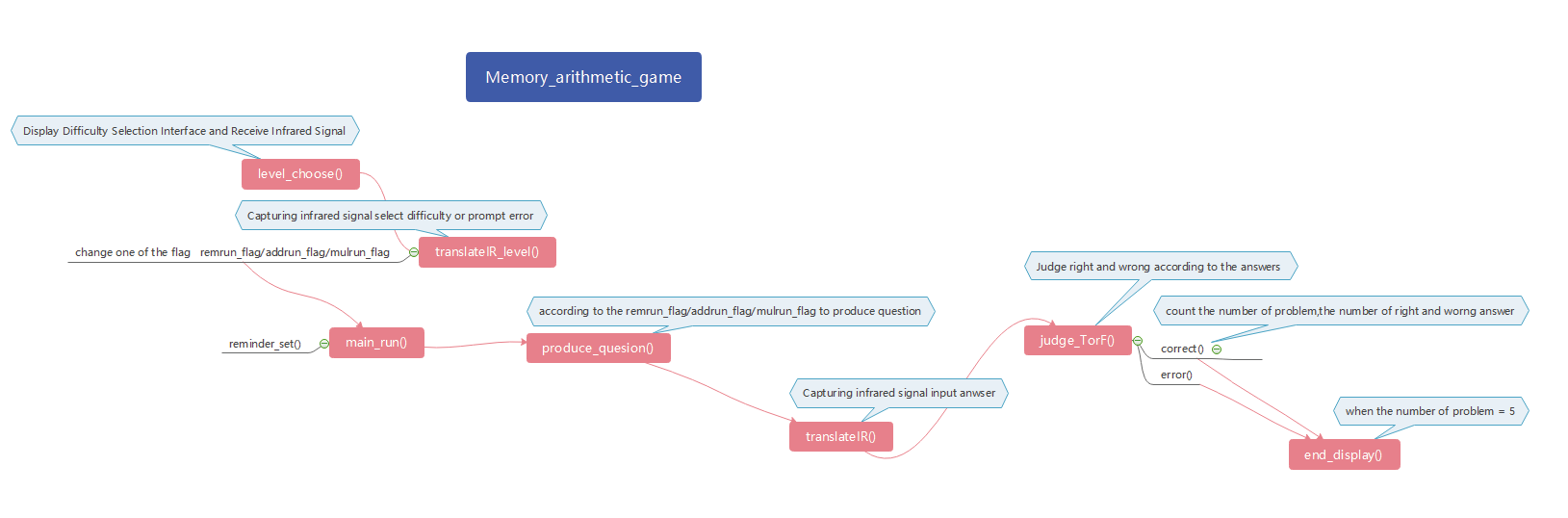
يفصل المخطط تتابع التنفيذ: تعرض level_choose() واجهة الصعوبة وتستقبل إشارة IR، ثم تلتقط translateIR_level() اختيار المستوى أو تعرض خطأ، وتغير أحد متغيرات الحالة remrun_flag أو addrun_flag أو mulrun_flag. يستدعي main_run() تهيئة متغيرات اللعبة عبر reminder_set()، ثم تنشئ produce_quesion() السؤال وفق متغير الحالة المحدد. تستقبل translateIR() الإجابة، وتحكم judge_TorF() على صحتها. تعد correct() و error() الأسئلة والإجابات الصحيحة والخاطئة؛ وعندما يصبح عدد الأسئلة 5، تعرض end_display() النتيجة.
التوصيل وأزرار جهاز التحكم عن بُعد (Infrared Remote Controller)
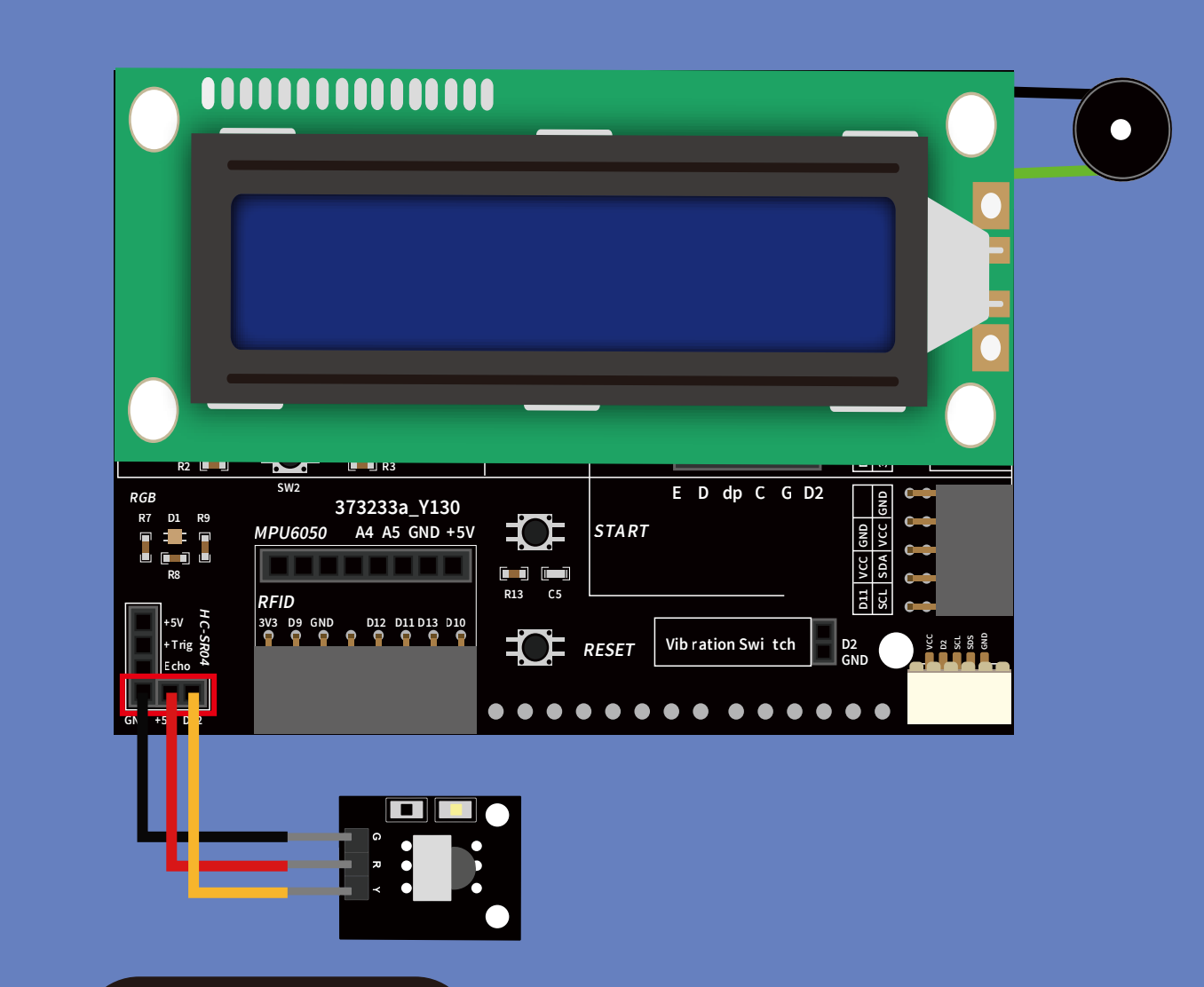
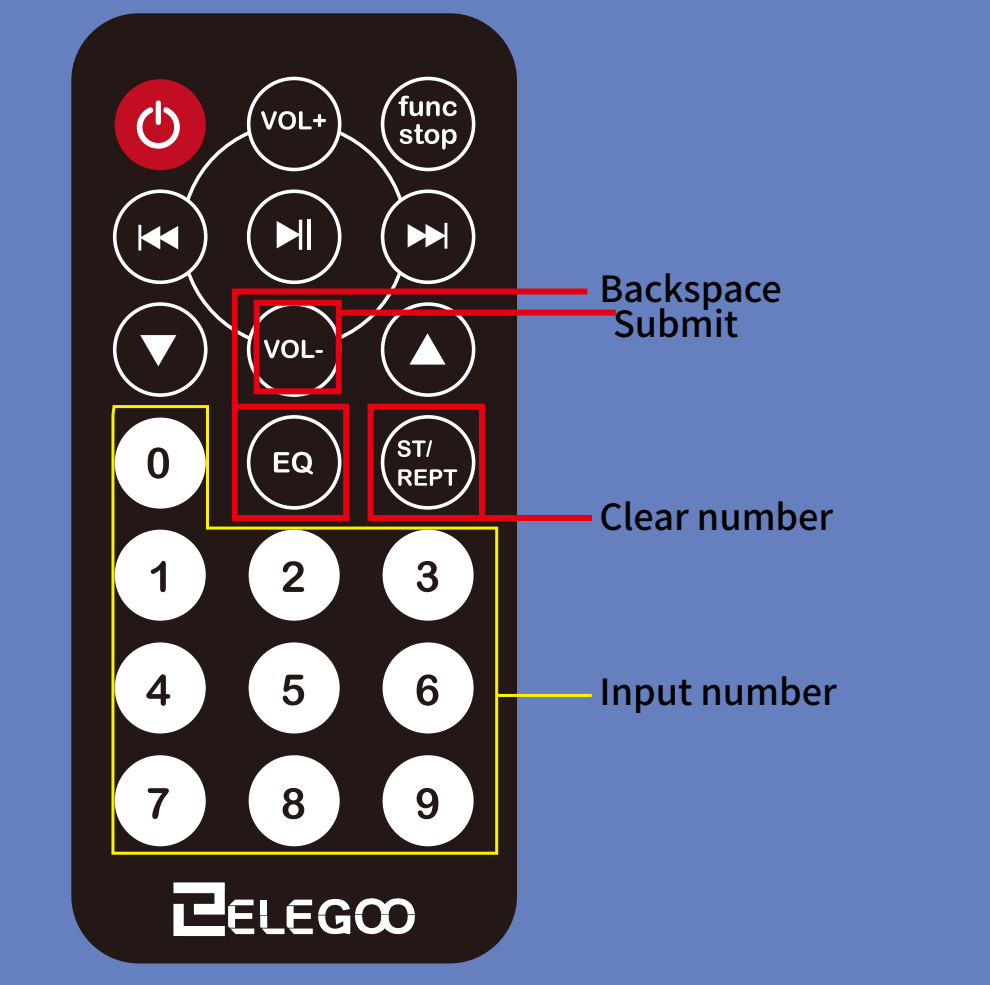
استخدم الأزرار 0–9 لإدخال العدد. في البرنامج Memory_arithmetic_game، يعيد EQ الإدخال إلى حالته السابقة لحذف آخر محرف، ويمسح ST/REPT العدد كاملًا، ويؤكد VOL- الإجابة.
تأكد من توفر LiquidCrystal و pitches، ومن وجود ملفات IRremote.cpp و IRremote.h و IRremoteInt.h في مجلد البرنامج قبل رفعه.
افتح ملف البرنامج Memory_arithmetic_game.ino من مجلد المشروع في بيئة Arduino IDE، مع إبقاء بقية ملفات المشروع في المجلد نفسه. وصّل لوحة أردوينو (UNO R3 Board) بالحاسوب بكابل توصيل (USB Cable)، ثم اضغط زر Upload (رفع) لنقل البرنامج إلى اللوحة وتشغيل اللعبة عليها. إذا ظهرت رسالة تشير إلى مكتبة مفقودة، فاتبع خطوات التثبيت في قسم «ما هي المكتبات؟» وطرق تثبيتها في الدرس 1.5 «وميض LED وإضافة المكتبات».
الكود
code/Memory_arithmetic_game/button_value.ino
void translateIR() // takes action based on IR code received
{
       switch(results.value)
      {
      case BTN_RET:btn_ret();break;       // Clear the input number when pressing RET key
      case BTN_EQ: read_pre_buf();break;  //withdraw
      case BTN_0: if(input_digital_cnt<7)
                  {
                    save_pre_buf();  //because we need to achieve the function of "BTN_EQ",so we must save the value we pressed always.
                    strcat(buf,"0");
                    //” The string splicing function in string.h will add "0" to form a new string, which can be referred to as the example above.
                    // Example: Enter "2" after 1 and then "5"
                    //                "2",    "21",       "125"
                  }break;
      case BTN_1: if(input_digital_cnt<7)
                  {
                    save_pre_buf();
                    strcat(buf,"1");
                   } break;
      case BTN_2: if(input_digital_cnt<7)
                  {
                    save_pre_buf();
                    strcat(buf,"2");
                    }break;
      case BTN_3: if(input_digital_cnt<7)
                  {
                    save_pre_buf();
                    strcat(buf,"3");
                    } break;
      case BTN_4: if(input_digital_cnt<7)
                  {
                    save_pre_buf();
                    strcat(buf,"4");
                    }break;
      case BTN_5: if(input_digital_cnt<7)
                  {
                    save_pre_buf();
                    strcat(buf,"5");
                    }break;
      case BTN_6: if(input_digital_cnt<7)
                  {
                    save_pre_buf();
                    strcat(buf,"6");
                    }break;
      case BTN_7: if(input_digital_cnt<7)
                  {
                    save_pre_buf();
                    strcat(buf,"7");
                    }break;
      case BTN_8: if(input_digital_cnt<7)
                  {
                    save_pre_buf();
                    strcat(buf,"8");
                    }break;
      case BTN_9: if(input_digital_cnt<7)
                  {
                    save_pre_buf();
                    strcat(buf,"9");
                    }break;

      case BTN_VOL:judge_TorF();break;   // Confirmation key, press to implement the corresponding algorithm
    }

  delay(200);
}

void btn_ret() //RET key answer data clear
{
  clr_answer();
  strcpy(buf,empty);
  input_digital_cnt=0;
 }


void read_pre_buf() //Read the last key value
{
  input_digital_cnt--;
  if(btn_cnt>0)
  {
  btn_cnt--;
  clr_answer();
  strcpy(buf,pre_buf[btn_cnt]);
  }
  else if(0==btn_cnt)
  {
     clr_answer();strcpy(buf,empty);
   }
}

void save_pre_buf()//Save the last key we have input.
{
  input_digital_cnt++;
  if(save_buf_flag)
  {
  strcpy(pre_buf[btn_cnt],buf);
  btn_cnt++;
  }
  save_buf_flag=1;
}
code/Memory_arithmetic_game/display.ino
void reminder_set()
{
  lcd.setCursor(0,0);
   lcd.print("Begin counting!!");
  }


void clr_answer()
{
  lcd.clear();
  lcd.setCursor(0,0);
  lcd.print("Begin counting!!");
  lcd.setCursor(0,1);
  }


void end_display()
{
  if(QUESTION_TOTAL_NUM==qut_cnt)
  {
      menu_flag=1;
      mulrun_flag=0;
      addrun_flag=0;
      remrun_flag=0;
      var_flag=1;
      qut_cnt=0;
      lcd.clear();
      lcd.setCursor(0,0);
      lcd.print("test ending");
      lcd.setCursor(0,1);
      lcd.print("   score:");
      lcd.print(T_cnt);
      //end_light_effect();
      end_voice_effect();
      T_cnt=0;
      delay(1000);
      lcd.clear();

    }
  }
code/Memory_arithmetic_game/IRremote.cpp
/*
 * IRremote
 * Version 0.11 August, 2009
 * Copyright 2009 Ken Shirriff
 * For details, see http://arcfn.com/2009/08/multi-protocol-infrared-remote-library.html
 *
 * Modified by Paul Stoffregen <paul@pjrc.com> to support other boards and timers
 * Modified  by Mitra Ardron <mitra@mitra.biz>
 * Added Sanyo and Mitsubishi controllers
 * Modified Sony to spot the repeat codes that some Sony's send
 *
 * Interrupt code based on NECIRrcv by Joe Knapp
 * http://www.arduino.cc/cgi-bin/yabb2/YaBB.pl?num=1210243556
 * Also influenced by http://zovirl.com/2008/11/12/building-a-universal-remote-with-an-arduino/
 *
 * JVC and Panasonic protocol added by Kristian Lauszus (Thanks to zenwheel and other people at the original blog post)
 * LG added by Darryl Smith (based on the JVC protocol)
 */

#include "IRremote.h"
#include "IRremoteInt.h"

// Provides ISR
#include <avr/interrupt.h>

volatile irparams_t irparams;

// These versions of MATCH, MATCH_MARK, and MATCH_SPACE are only for debugging.
// To use them, set DEBUG in IRremoteInt.h
// Normally macros are used for efficiency
#ifdef DEBUG
int MATCH(int measured, int desired) {
  Serial.print("Testing: ");
  Serial.print(TICKS_LOW(desired), DEC);
  Serial.print(" <= ");
  Serial.print(measured, DEC);
  Serial.print(" <= ");
  Serial.println(TICKS_HIGH(desired), DEC);
  return measured >= TICKS_LOW(desired) && measured <= TICKS_HIGH(desired);
}

int MATCH_MARK(int measured_ticks, int desired_us) {
  Serial.print("Testing mark ");
  Serial.print(measured_ticks * USECPERTICK, DEC);
  Serial.print(" vs ");
  Serial.print(desired_us, DEC);
  Serial.print(": ");
  Serial.print(TICKS_LOW(desired_us + MARK_EXCESS), DEC);
  Serial.print(" <= ");
  Serial.print(measured_ticks, DEC);
  Serial.print(" <= ");
  Serial.println(TICKS_HIGH(desired_us + MARK_EXCESS), DEC);
  return measured_ticks >= TICKS_LOW(desired_us + MARK_EXCESS) && measured_ticks <= TICKS_HIGH(desired_us + MARK_EXCESS);
}

int MATCH_SPACE(int measured_ticks, int desired_us) {
  Serial.print("Testing space ");
  Serial.print(measured_ticks * USECPERTICK, DEC);
  Serial.print(" vs ");
  Serial.print(desired_us, DEC);
  Serial.print(": ");
  Serial.print(TICKS_LOW(desired_us - MARK_EXCESS), DEC);
  Serial.print(" <= ");
  Serial.print(measured_ticks, DEC);
  Serial.print(" <= ");
  Serial.println(TICKS_HIGH(desired_us - MARK_EXCESS), DEC);
  return measured_ticks >= TICKS_LOW(desired_us - MARK_EXCESS) && measured_ticks <= TICKS_HIGH(desired_us - MARK_EXCESS);
}
#else
int MATCH(int measured, int desired) {return measured >= TICKS_LOW(desired) && measured <= TICKS_HIGH(desired);}
int MATCH_MARK(int measured_ticks, int desired_us) {return MATCH(measured_ticks, desired_us );}
int MATCH_SPACE(int measured_ticks, int desired_us) {return MATCH(measured_ticks, desired_us);}
// Debugging versions are in IRremote.cpp
#endif

void IRsend::sendNEC(unsigned long data, int nbits)
{
  enableIROut(38);
  mark(NEC_HDR_MARK);
  space(NEC_HDR_SPACE);
  for (int i = 0; i < nbits; i++) {
    if (data & TOPBIT) {
      mark(NEC_BIT_MARK);
      space(NEC_ONE_SPACE);
    }
    else {
      mark(NEC_BIT_MARK);
      space(NEC_ZERO_SPACE);
    }
    data <<= 1;
  }
  mark(NEC_BIT_MARK);
  space(0);
}

void IRsend::sendSony(unsigned long data, int nbits) {
  enableIROut(40);
  mark(SONY_HDR_MARK);
  space(SONY_HDR_SPACE);
  data = data << (32 - nbits);
  for (int i = 0; i < nbits; i++) {
    if (data & TOPBIT) {
      mark(SONY_ONE_MARK);
      space(SONY_HDR_SPACE);
    }
    else {
      mark(SONY_ZERO_MARK);
      space(SONY_HDR_SPACE);
    }
    data <<= 1;
  }
}

void IRsend::sendRaw(unsigned int buf[], int len, int hz)
{
  enableIROut(hz);
  for (int i = 0; i < len; i++) {
    if (i & 1) {
      space(buf[i]);
    }
    else {
      mark(buf[i]);
    }
  }
  space(0); // Just to be sure
}

// Note: first bit must be a one (start bit)
void IRsend::sendRC5(unsigned long data, int nbits)
{
  enableIROut(36);
  data = data << (32 - nbits);
  mark(RC5_T1); // First start bit
  space(RC5_T1); // Second start bit
  mark(RC5_T1); // Second start bit
  for (int i = 0; i < nbits; i++) {
    if (data & TOPBIT) {
      space(RC5_T1); // 1 is space, then mark
      mark(RC5_T1);
    }
    else {
      mark(RC5_T1);
      space(RC5_T1);
    }
    data <<= 1;
  }
  space(0); // Turn off at end
}

// Caller needs to take care of flipping the toggle bit
void IRsend::sendRC6(unsigned long data, int nbits)
{
  enableIROut(36);
  data = data << (32 - nbits);
  mark(RC6_HDR_MARK);
  space(RC6_HDR_SPACE);
  mark(RC6_T1); // start bit
  space(RC6_T1);
  int t;
  for (int i = 0; i < nbits; i++) {
    if (i == 3) {
      // double-wide trailer bit
      t = 2 * RC6_T1;
    }
    else {
      t = RC6_T1;
    }
    if (data & TOPBIT) {
      mark(t);
      space(t);
    }
    else {
      space(t);
      mark(t);
    }

    data <<= 1;
  }
  space(0); // Turn off at end
}
void IRsend::sendPanasonic(unsigned int address, unsigned long data) {
    enableIROut(35);
    mark(PANASONIC_HDR_MARK);
    space(PANASONIC_HDR_SPACE);

    for(int i=0;i<16;i++)
    {
        mark(PANASONIC_BIT_MARK);
        if (address & 0x8000) {
            space(PANASONIC_ONE_SPACE);
        } else {
            space(PANASONIC_ZERO_SPACE);
        }
        address <<= 1;
    }
    for (int i=0; i < 32; i++) {
        mark(PANASONIC_BIT_MARK);
        if (data & TOPBIT) {
            space(PANASONIC_ONE_SPACE);
        } else {
            space(PANASONIC_ZERO_SPACE);
        }
        data <<= 1;
    }
    mark(PANASONIC_BIT_MARK);
    space(0);
}
void IRsend::sendJVC(unsigned long data, int nbits, int repeat)
{
    enableIROut(38);
    data = data << (32 - nbits);
    if (!repeat){
        mark(JVC_HDR_MARK);
        space(JVC_HDR_SPACE);
    }
    for (int i = 0; i < nbits; i++) {
        if (data & TOPBIT) {
            mark(JVC_BIT_MARK);
            space(JVC_ONE_SPACE);
        }
        else {
            mark(JVC_BIT_MARK);
            space(JVC_ZERO_SPACE);
        }
        data <<= 1;
    }
    mark(JVC_BIT_MARK);
    space(0);
}

void IRsend::sendSAMSUNG(unsigned long data, int nbits)
{
  enableIROut(38);
  mark(SAMSUNG_HDR_MARK);
  space(SAMSUNG_HDR_SPACE);
  for (int i = 0; i < nbits; i++) {
    if (data & TOPBIT) {
      mark(SAMSUNG_BIT_MARK);
      space(SAMSUNG_ONE_SPACE);
    }
    else {
      mark(SAMSUNG_BIT_MARK);
      space(SAMSUNG_ZERO_SPACE);
    }
    data <<= 1;
  }
  mark(SAMSUNG_BIT_MARK);
  space(0);
}

void IRsend::mark(int time) {
  // Sends an IR mark for the specified number of microseconds.
  // The mark output is modulated at the PWM frequency.
  TIMER_ENABLE_PWM; // Enable pin 3 PWM output
  if (time > 0) delayMicroseconds(time);
}

/* Leave pin off for time (given in microseconds) */
void IRsend::space(int time) {
  // Sends an IR space for the specified number of microseconds.
  // A space is no output, so the PWM output is disabled.
  TIMER_DISABLE_PWM; // Disable pin 3 PWM output
  if (time > 0) delayMicroseconds(time);
}

void IRsend::enableIROut(int khz) {
  // Enables IR output.  The khz value controls the modulation frequency in kilohertz.
  // The IR output will be on pin 3 (OC2B).
  // This routine is designed for 36-40KHz; if you use it for other values, it's up to you
  // to make sure it gives reasonable results.  (Watch out for overflow / underflow / rounding.)
  // TIMER2 is used in phase-correct PWM mode, with OCR2A controlling the frequency and OCR2B
  // controlling the duty cycle.
  // There is no prescaling, so the output frequency is 16MHz / (2 * OCR2A)
  // To turn the output on and off, we leave the PWM running, but connect and disconnect the output pin.
  // A few hours staring at the ATmega documentation and this will all make sense.
  // See my Secrets of Arduino PWM at http://arcfn.com/2009/07/secrets-of-arduino-pwm.html for details.


  // Disable the Timer2 Interrupt (which is used for receiving IR)
  TIMER_DISABLE_INTR; //Timer2 Overflow Interrupt

  pinMode(TIMER_PWM_PIN, OUTPUT);
  digitalWrite(TIMER_PWM_PIN, LOW); // When not sending PWM, we want it low

  // COM2A = 00: disconnect OC2A
  // COM2B = 00: disconnect OC2B; to send signal set to 10: OC2B non-inverted
  // WGM2 = 101: phase-correct PWM with OCRA as top
  // CS2 = 000: no prescaling
  // The top value for the timer.  The modulation frequency will be SYSCLOCK / 2 / OCR2A.
  TIMER_CONFIG_KHZ(khz);
}

IRrecv::IRrecv(int recvpin)
{
  irparams.recvpin = recvpin;
  irparams.blinkflag = 0;
}

// initialization
void IRrecv::enableIRIn() {
  cli();
  // setup pulse clock timer interrupt
  //Prescale /8 (16M/8 = 0.5 microseconds per tick)
  // Therefore, the timer interval can range from 0.5 to 128 microseconds
  // depending on the reset value (255 to 0)
  TIMER_CONFIG_NORMAL();

  //Timer2 Overflow Interrupt Enable
  TIMER_ENABLE_INTR;

  TIMER_RESET;

  sei();  // enable interrupts

  // initialize state machine variables
  irparams.rcvstate = STATE_IDLE;
  irparams.rawlen = 0;

  // set pin modes
  pinMode(irparams.recvpin, INPUT);
}

// enable/disable blinking of pin 13 on IR processing
void IRrecv::blink13(int blinkflag)
{
  irparams.blinkflag = blinkflag;
  if (blinkflag)
    pinMode(BLINKLED, OUTPUT);
}

// TIMER2 interrupt code to collect raw data.
// Widths of alternating SPACE, MARK are recorded in rawbuf.
// Recorded in ticks of 50 microseconds.
// rawlen counts the number of entries recorded so far.
// First entry is the SPACE between transmissions.
// As soon as a SPACE gets long, ready is set, state switches to IDLE, timing of SPACE continues.
// As soon as first MARK arrives, gap width is recorded, ready is cleared, and new logging starts
ISR(TIMER_INTR_NAME)
{
  TIMER_RESET;

  uint8_t irdata = (uint8_t)digitalRead(irparams.recvpin);

  irparams.timer++; // One more 50us tick
  if (irparams.rawlen >= RAWBUF) {
    // Buffer overflow
    irparams.rcvstate = STATE_STOP;
  }
  switch(irparams.rcvstate) {
  case STATE_IDLE: // In the middle of a gap
    if (irdata == MARK) {
      if (irparams.timer < GAP_TICKS) {
        // Not big enough to be a gap.
        irparams.timer = 0;
      }
      else {
        // gap just ended, record duration and start recording transmission
        irparams.rawlen = 0;
        irparams.rawbuf[irparams.rawlen++] = irparams.timer;
        irparams.timer = 0;
        irparams.rcvstate = STATE_MARK;
      }
    }
    break;
  case STATE_MARK: // timing MARK
    if (irdata == SPACE) {   // MARK ended, record time
      irparams.rawbuf[irparams.rawlen++] = irparams.timer;
      irparams.timer = 0;
      irparams.rcvstate = STATE_SPACE;
    }
    break;
  case STATE_SPACE: // timing SPACE
    if (irdata == MARK) { // SPACE just ended, record it
      irparams.rawbuf[irparams.rawlen++] = irparams.timer;
      irparams.timer = 0;
      irparams.rcvstate = STATE_MARK;
    }
    else { // SPACE
      if (irparams.timer > GAP_TICKS) {
        // big SPACE, indicates gap between codes
        // Mark current code as ready for processing
        // Switch to STOP
        // Don't reset timer; keep counting space width
        irparams.rcvstate = STATE_STOP;
      }
    }
    break;
  case STATE_STOP: // waiting, measuring gap
    if (irdata == MARK) { // reset gap timer
      irparams.timer = 0;
    }
    break;
  }

  if (irparams.blinkflag) {
    if (irdata == MARK) {
      BLINKLED_ON();  // turn pin 13 LED on
    }
    else {
      BLINKLED_OFF();  // turn pin 13 LED off
    }
  }
}

void IRrecv::resume() {
  irparams.rcvstate = STATE_IDLE;
  irparams.rawlen = 0;
}


// Decodes the received IR message
// Returns 0 if no data ready, 1 if data ready.
// Results of decoding are stored in results
int IRrecv::decode(decode_results *results) {
  results->rawbuf = irparams.rawbuf;
  results->rawlen = irparams.rawlen;
  if (irparams.rcvstate != STATE_STOP) {
    return ERR;
  }
#ifdef DEBUG
  Serial.println("Attempting NEC decode");
#endif
  if (decodeNEC(results)) {
    return DECODED;
  }
#ifdef DEBUG
  Serial.println("Attempting Sony decode");
#endif
  if (decodeSony(results)) {
    return DECODED;
  }
#ifdef DEBUG
  Serial.println("Attempting Sanyo decode");
#endif
  if (decodeSanyo(results)) {
    return DECODED;
  }
#ifdef DEBUG
  Serial.println("Attempting Mitsubishi decode");
#endif
  if (decodeMitsubishi(results)) {
    return DECODED;
  }
#ifdef DEBUG
  Serial.println("Attempting RC5 decode");
#endif
  if (decodeRC5(results)) {
    return DECODED;
  }
#ifdef DEBUG
  Serial.println("Attempting RC6 decode");
#endif
  if (decodeRC6(results)) {
    return DECODED;
  }
#ifdef DEBUG
    Serial.println("Attempting Panasonic decode");
#endif
    if (decodePanasonic(results)) {
        return DECODED;
    }
#ifdef DEBUG
    Serial.println("Attempting LG decode");
#endif
    if (decodeLG(results)) {
        return DECODED;
    }
#ifdef DEBUG
    Serial.println("Attempting JVC decode");
#endif
    if (decodeJVC(results)) {
        return DECODED;
    }
#ifdef DEBUG
  Serial.println("Attempting SAMSUNG decode");
#endif
  if (decodeSAMSUNG(results)) {
    return DECODED;
  }
  // decodeHash returns a hash on any input.
  // Thus, it needs to be last in the list.
  // If you add any decodes, add them before this.
  if (decodeHash(results)) {
    return DECODED;
  }
  // Throw away and start over
  resume();
  return ERR;
}

// NECs have a repeat only 4 items long
long IRrecv::decodeNEC(decode_results *results) {
  long data = 0;
  int offset = 1; // Skip first space
  // Initial mark
  if (!MATCH_MARK(results->rawbuf[offset], NEC_HDR_MARK)) {
    return ERR;
  }
  offset++;
  // Check for repeat
  if (irparams.rawlen == 4 &&
    MATCH_SPACE(results->rawbuf[offset], NEC_RPT_SPACE) &&
    MATCH_MARK(results->rawbuf[offset+1], NEC_BIT_MARK)) {
    results->bits = 0;
    results->value = REPEAT;
    results->decode_type = NEC;
    return DECODED;
  }
  if (irparams.rawlen < 2 * NEC_BITS + 4) {
    return ERR;
  }
  // Initial space
  if (!MATCH_SPACE(results->rawbuf[offset], NEC_HDR_SPACE)) {
    return ERR;
  }
  offset++;
  for (int i = 0; i < NEC_BITS; i++) {
    if (!MATCH_MARK(results->rawbuf[offset], NEC_BIT_MARK)) {
      return ERR;
    }
    offset++;
    if (MATCH_SPACE(results->rawbuf[offset], NEC_ONE_SPACE)) {
      data = (data << 1) | 1;
    }
    else if (MATCH_SPACE(results->rawbuf[offset], NEC_ZERO_SPACE)) {
      data <<= 1;
    }
    else {
      return ERR;
    }
    offset++;
  }
  // Success
  results->bits = NEC_BITS;
  results->value = data;
  results->decode_type = NEC;
  return DECODED;
}

long IRrecv::decodeSony(decode_results *results) {
  long data = 0;
  if (irparams.rawlen < 2 * SONY_BITS + 2) {
    return ERR;
  }
  int offset = 0; // Dont skip first space, check its size

  // Some Sony's deliver repeats fast after first
  // unfortunately can't spot difference from of repeat from two fast clicks
  if (results->rawbuf[offset] < SONY_DOUBLE_SPACE_USECS) {
    // Serial.print("IR Gap found: ");
    results->bits = 0;
    results->value = REPEAT;
    results->decode_type = SANYO;
    return DECODED;
  }
  offset++;

  // Initial mark
  if (!MATCH_MARK(results->rawbuf[offset], SONY_HDR_MARK)) {
    return ERR;
  }
  offset++;

  while (offset + 1 < irparams.rawlen) {
    if (!MATCH_SPACE(results->rawbuf[offset], SONY_HDR_SPACE)) {
      break;
    }
    offset++;
    if (MATCH_MARK(results->rawbuf[offset], SONY_ONE_MARK)) {
      data = (data << 1) | 1;
    }
    else if (MATCH_MARK(results->rawbuf[offset], SONY_ZERO_MARK)) {
      data <<= 1;
    }
    else {
      return ERR;
    }
    offset++;
  }

  // Success
  results->bits = (offset - 1) / 2;
  if (results->bits < 12) {
    results->bits = 0;
    return ERR;
  }
  results->value = data;
  results->decode_type = SONY;
  return DECODED;
}

// I think this is a Sanyo decoder - serial = SA 8650B
// Looks like Sony except for timings, 48 chars of data and time/space different
long IRrecv::decodeSanyo(decode_results *results) {
  long data = 0;
  if (irparams.rawlen < 2 * SANYO_BITS + 2) {
    return ERR;
  }
  int offset = 0; // Skip first space
  // Initial space
  /* Put this back in for debugging - note can't use #DEBUG as if Debug on we don't see the repeat cos of the delay
  Serial.print("IR Gap: ");
  Serial.println( results->rawbuf[offset]);
  Serial.println( "test against:");
  Serial.println(results->rawbuf[offset]);
  */
  if (results->rawbuf[offset] < SANYO_DOUBLE_SPACE_USECS) {
    // Serial.print("IR Gap found: ");
    results->bits = 0;
    results->value = REPEAT;
    results->decode_type = SANYO;
    return DECODED;
  }
  offset++;

  // Initial mark
  if (!MATCH_MARK(results->rawbuf[offset], SANYO_HDR_MARK)) {
    return ERR;
  }
  offset++;

  // Skip Second Mark
  if (!MATCH_MARK(results->rawbuf[offset], SANYO_HDR_MARK)) {
    return ERR;
  }
  offset++;

  while (offset + 1 < irparams.rawlen) {
    if (!MATCH_SPACE(results->rawbuf[offset], SANYO_HDR_SPACE)) {
      break;
    }
    offset++;
    if (MATCH_MARK(results->rawbuf[offset], SANYO_ONE_MARK)) {
      data = (data << 1) | 1;
    }
    else if (MATCH_MARK(results->rawbuf[offset], SANYO_ZERO_MARK)) {
      data <<= 1;
    }
    else {
      return ERR;
    }
    offset++;
  }

  // Success
  results->bits = (offset - 1) / 2;
  if (results->bits < 12) {
    results->bits = 0;
    return ERR;
  }
  results->value = data;
  results->decode_type = SANYO;
  return DECODED;
}

// Looks like Sony except for timings, 48 chars of data and time/space different
long IRrecv::decodeMitsubishi(decode_results *results) {
  // Serial.print("?!? decoding Mitsubishi:");Serial.print(irparams.rawlen); Serial.print(" want "); Serial.println( 2 * MITSUBISHI_BITS + 2);
  long data = 0;
  if (irparams.rawlen < 2 * MITSUBISHI_BITS + 2) {
    return ERR;
  }
  int offset = 0; // Skip first space
  // Initial space
  /* Put this back in for debugging - note can't use #DEBUG as if Debug on we don't see the repeat cos of the delay
  Serial.print("IR Gap: ");
  Serial.println( results->rawbuf[offset]);
  Serial.println( "test against:");
  Serial.println(results->rawbuf[offset]);
  */
  /* Not seeing double keys from Mitsubishi
  if (results->rawbuf[offset] < MITSUBISHI_DOUBLE_SPACE_USECS) {
    // Serial.print("IR Gap found: ");
    results->bits = 0;
    results->value = REPEAT;
    results->decode_type = MITSUBISHI;
    return DECODED;
  }
  */
  offset++;

  // Typical
  // 14200 7 41 7 42 7 42 7 17 7 17 7 18 7 41 7 18 7 17 7 17 7 18 7 41 8 17 7 17 7 18 7 17 7

  // Initial Space
  if (!MATCH_MARK(results->rawbuf[offset], MITSUBISHI_HDR_SPACE)) {
    return ERR;
  }
  offset++;
  while (offset + 1 < irparams.rawlen) {
    if (MATCH_MARK(results->rawbuf[offset], MITSUBISHI_ONE_MARK)) {
      data = (data << 1) | 1;
    }
    else if (MATCH_MARK(results->rawbuf[offset], MITSUBISHI_ZERO_MARK)) {
      data <<= 1;
    }
    else {
      // Serial.println("A"); Serial.println(offset); Serial.println(results->rawbuf[offset]);
      return ERR;
    }
    offset++;
    if (!MATCH_SPACE(results->rawbuf[offset], MITSUBISHI_HDR_SPACE)) {
      // Serial.println("B"); Serial.println(offset); Serial.println(results->rawbuf[offset]);
      break;
    }
    offset++;
  }

  // Success
  results->bits = (offset - 1) / 2;
  if (results->bits < MITSUBISHI_BITS) {
    results->bits = 0;
    return ERR;
  }
  results->value = data;
  results->decode_type = MITSUBISHI;
  return DECODED;
}


// Gets one undecoded level at a time from the raw buffer.
// The RC5/6 decoding is easier if the data is broken into time intervals.
// E.g. if the buffer has MARK for 2 time intervals and SPACE for 1,
// successive calls to getRClevel will return MARK, MARK, SPACE.
// offset and used are updated to keep track of the current position.
// t1 is the time interval for a single bit in microseconds.
// Returns -1 for error (measured time interval is not a multiple of t1).
int IRrecv::getRClevel(decode_results *results, int *offset, int *used, int t1) {
  if (*offset >= results->rawlen) {
    // After end of recorded buffer, assume SPACE.
    return SPACE;
  }
  int width = results->rawbuf[*offset];
  int val = ((*offset) % 2) ? MARK : SPACE;
  int correction = (val == MARK) ? MARK_EXCESS : - MARK_EXCESS;

  int avail;
  if (MATCH(width, t1 + correction)) {
    avail = 1;
  }
  else if (MATCH(width, 2*t1 + correction)) {
    avail = 2;
  }
  else if (MATCH(width, 3*t1 + correction)) {
    avail = 3;
  }
  else {
    return -1;
  }

  (*used)++;
  if (*used >= avail) {
    *used = 0;
    (*offset)++;
  }
#ifdef DEBUG
  if (val == MARK) {
    Serial.println("MARK");
  }
  else {
    Serial.println("SPACE");
  }
#endif
  return val;
}

long IRrecv::decodeRC5(decode_results *results) {
  if (irparams.rawlen < MIN_RC5_SAMPLES + 2) {
    return ERR;
  }
  int offset = 1; // Skip gap space
  long data = 0;
  int used = 0;
  // Get start bits
  if (getRClevel(results, &offset, &used, RC5_T1) != MARK) return ERR;
  if (getRClevel(results, &offset, &used, RC5_T1) != SPACE) return ERR;
  if (getRClevel(results, &offset, &used, RC5_T1) != MARK) return ERR;
  int nbits;
  for (nbits = 0; offset < irparams.rawlen; nbits++) {
    int levelA = getRClevel(results, &offset, &used, RC5_T1);
    int levelB = getRClevel(results, &offset, &used, RC5_T1);
    if (levelA == SPACE && levelB == MARK) {
      // 1 bit
      data = (data << 1) | 1;
    }
    else if (levelA == MARK && levelB == SPACE) {
      // zero bit
      data <<= 1;
    }
    else {
      return ERR;
    }
  }

  // Success
  results->bits = nbits;
  results->value = data;
  results->decode_type = RC5;
  return DECODED;
}

long IRrecv::decodeRC6(decode_results *results) {
  if (results->rawlen < MIN_RC6_SAMPLES) {
    return ERR;
  }
  int offset = 1; // Skip first space
  // Initial mark
  if (!MATCH_MARK(results->rawbuf[offset], RC6_HDR_MARK)) {
    return ERR;
  }
  offset++;
  if (!MATCH_SPACE(results->rawbuf[offset], RC6_HDR_SPACE)) {
    return ERR;
  }
  offset++;
  long data = 0;
  int used = 0;
  // Get start bit (1)
  if (getRClevel(results, &offset, &used, RC6_T1) != MARK) return ERR;
  if (getRClevel(results, &offset, &used, RC6_T1) != SPACE) return ERR;
  int nbits;
  for (nbits = 0; offset < results->rawlen; nbits++) {
    int levelA, levelB; // Next two levels
    levelA = getRClevel(results, &offset, &used, RC6_T1);
    if (nbits == 3) {
      // T bit is double wide; make sure second half matches
      if (levelA != getRClevel(results, &offset, &used, RC6_T1)) return ERR;
    }
    levelB = getRClevel(results, &offset, &used, RC6_T1);
    if (nbits == 3) {
      // T bit is double wide; make sure second half matches
      if (levelB != getRClevel(results, &offset, &used, RC6_T1)) return ERR;
    }
    if (levelA == MARK && levelB == SPACE) { // reversed compared to RC5
      // 1 bit
      data = (data << 1) | 1;
    }
    else if (levelA == SPACE && levelB == MARK) {
      // zero bit
      data <<= 1;
    }
    else {
      return ERR; // Error
    }
  }
  // Success
  results->bits = nbits;
  results->value = data;
  results->decode_type = RC6;
  return DECODED;
}
long IRrecv::decodePanasonic(decode_results *results) {
    unsigned long long data = 0;
    int offset = 1;

    if (!MATCH_MARK(results->rawbuf[offset], PANASONIC_HDR_MARK)) {
        return ERR;
    }
    offset++;
    if (!MATCH_MARK(results->rawbuf[offset], PANASONIC_HDR_SPACE)) {
        return ERR;
    }
    offset++;

    // decode address
    for (int i = 0; i < PANASONIC_BITS; i++) {
        if (!MATCH_MARK(results->rawbuf[offset++], PANASONIC_BIT_MARK)) {
            return ERR;
        }
        if (MATCH_SPACE(results->rawbuf[offset],PANASONIC_ONE_SPACE)) {
            data = (data << 1) | 1;
        } else if (MATCH_SPACE(results->rawbuf[offset],PANASONIC_ZERO_SPACE)) {
            data <<= 1;
        } else {
            return ERR;
        }
        offset++;
    }
    results->value = (unsigned long)data;
    results->panasonicAddress = (unsigned int)(data >> 32);
    results->decode_type = PANASONIC;
    results->bits = PANASONIC_BITS;
    return DECODED;
}

long IRrecv::decodeLG(decode_results *results) {
    long data = 0;
    int offset = 1; // Skip first space

    // Initial mark
    if (!MATCH_MARK(results->rawbuf[offset], LG_HDR_MARK)) {
        return ERR;
    }
    offset++;
    if (irparams.rawlen < 2 * LG_BITS + 1 ) {
        return ERR;
    }
    // Initial space
    if (!MATCH_SPACE(results->rawbuf[offset], LG_HDR_SPACE)) {
        return ERR;
    }
    offset++;
    for (int i = 0; i < LG_BITS; i++) {
        if (!MATCH_MARK(results->rawbuf[offset], LG_BIT_MARK)) {
            return ERR;
        }
        offset++;
        if (MATCH_SPACE(results->rawbuf[offset], LG_ONE_SPACE)) {
            data = (data << 1) | 1;
        }
        else if (MATCH_SPACE(results->rawbuf[offset], LG_ZERO_SPACE)) {
            data <<= 1;
        }
        else {
            return ERR;
        }
        offset++;
    }
    //Stop bit
    if (!MATCH_MARK(results->rawbuf[offset], LG_BIT_MARK)){
        return ERR;
    }
    // Success
    results->bits = LG_BITS;
    results->value = data;
    results->decode_type = LG;
    return DECODED;
}


long IRrecv::decodeJVC(decode_results *results) {
    long data = 0;
    int offset = 1; // Skip first space
    // Check for repeat
    if (irparams.rawlen - 1 == 33 &&
        MATCH_MARK(results->rawbuf[offset], JVC_BIT_MARK) &&
        MATCH_MARK(results->rawbuf[irparams.rawlen-1], JVC_BIT_MARK)) {
        results->bits = 0;
        results->value = REPEAT;
        results->decode_type = JVC;
        return DECODED;
    }
    // Initial mark
    if (!MATCH_MARK(results->rawbuf[offset], JVC_HDR_MARK)) {
        return ERR;
    }
    offset++;
    if (irparams.rawlen < 2 * JVC_BITS + 1 ) {
        return ERR;
    }
    // Initial space
    if (!MATCH_SPACE(results->rawbuf[offset], JVC_HDR_SPACE)) {
        return ERR;
    }
    offset++;
    for (int i = 0; i < JVC_BITS; i++) {
        if (!MATCH_MARK(results->rawbuf[offset], JVC_BIT_MARK)) {
            return ERR;
        }
        offset++;
        if (MATCH_SPACE(results->rawbuf[offset], JVC_ONE_SPACE)) {
            data = (data << 1) | 1;
        }
        else if (MATCH_SPACE(results->rawbuf[offset], JVC_ZERO_SPACE)) {
            data <<= 1;
        }
        else {
            return ERR;
        }
        offset++;
    }
    //Stop bit
    if (!MATCH_MARK(results->rawbuf[offset], JVC_BIT_MARK)){
        return ERR;
    }
    // Success
    results->bits = JVC_BITS;
    results->value = data;
    results->decode_type = JVC;
    return DECODED;
}

// SAMSUNGs have a repeat only 4 items long
long IRrecv::decodeSAMSUNG(decode_results *results) {
  long data = 0;
  int offset = 1; // Skip first space
  // Initial mark
  if (!MATCH_MARK(results->rawbuf[offset], SAMSUNG_HDR_MARK)) {
    return ERR;
  }
  offset++;
  // Check for repeat
  if (irparams.rawlen == 4 &&
    MATCH_SPACE(results->rawbuf[offset], SAMSUNG_RPT_SPACE) &&
    MATCH_MARK(results->rawbuf[offset+1], SAMSUNG_BIT_MARK)) {
    results->bits = 0;
    results->value = REPEAT;
    results->decode_type = SAMSUNG;
    return DECODED;
  }
  if (irparams.rawlen < 2 * SAMSUNG_BITS + 4) {
    return ERR;
  }
  // Initial space
  if (!MATCH_SPACE(results->rawbuf[offset], SAMSUNG_HDR_SPACE)) {
    return ERR;
  }
  offset++;
  for (int i = 0; i < SAMSUNG_BITS; i++) {
    if (!MATCH_MARK(results->rawbuf[offset], SAMSUNG_BIT_MARK)) {
      return ERR;
    }
    offset++;
    if (MATCH_SPACE(results->rawbuf[offset], SAMSUNG_ONE_SPACE)) {
      data = (data << 1) | 1;
    }
    else if (MATCH_SPACE(results->rawbuf[offset], SAMSUNG_ZERO_SPACE)) {
      data <<= 1;
    }
    else {
      return ERR;
    }
    offset++;
  }
  // Success
  results->bits = SAMSUNG_BITS;
  results->value = data;
  results->decode_type = SAMSUNG;
  return DECODED;
}

/* -----------------------------------------------------------------------
 * hashdecode - decode an arbitrary IR code.
 * Instead of decoding using a standard encoding scheme
 * (e.g. Sony, NEC, RC5), the code is hashed to a 32-bit value.
 *
 * The algorithm: look at the sequence of MARK signals, and see if each one
 * is shorter (0), the same length (1), or longer (2) than the previous.
 * Do the same with the SPACE signals.  Hszh the resulting sequence of 0's,
 * 1's, and 2's to a 32-bit value.  This will give a unique value for each
 * different code (probably), for most code systems.
 *
 * http://arcfn.com/2010/01/using-arbitrary-remotes-with-arduino.html
 */

// Compare two tick values, returning 0 if newval is shorter,
// 1 if newval is equal, and 2 if newval is longer
// Use a tolerance of 20%
int IRrecv::compare(unsigned int oldval, unsigned int newval) {
  if (newval < oldval * .8) {
    return 0;
  }
  else if (oldval < newval * .8) {
    return 2;
  }
  else {
    return 1;
  }
}

// Use FNV hash algorithm: http://isthe.com/chongo/tech/comp/fnv/#FNV-param
#define FNV_PRIME_32 16777619
#define FNV_BASIS_32 2166136261

/* Converts the raw code values into a 32-bit hash code.
 * Hopefully this code is unique for each button.
 * This isn't a "real" decoding, just an arbitrary value.
 */
long IRrecv::decodeHash(decode_results *results) {
  // Require at least 6 samples to prevent triggering on noise
  if (results->rawlen < 6) {
    return ERR;
  }
  long hash = FNV_BASIS_32;
  for (int i = 1; i+2 < results->rawlen; i++) {
    int value =  compare(results->rawbuf[i], results->rawbuf[i+2]);
    // Add value into the hash
    hash = (hash * FNV_PRIME_32) ^ value;
  }
  results->value = hash;
  results->bits = 32;
  results->decode_type = UNKNOWN;
  return DECODED;
}

/* Sharp and DISH support by Todd Treece ( http://unionbridge.org/design/ircommand )

The Dish send function needs to be repeated 4 times, and the Sharp function
has the necessary repeat built in because of the need to invert the signal.

Sharp protocol documentation:
http://www.sbprojects.com/knowledge/ir/sharp.htm

Here are the LIRC files that I found that seem to match the remote codes
from the oscilloscope:

Sharp LCD TV:
http://lirc.sourceforge.net/remotes/sharp/GA538WJSA

DISH NETWORK (echostar 301):
http://lirc.sourceforge.net/remotes/echostar/301_501_3100_5100_58xx_59xx

For the DISH codes, only send the last for characters of the hex.
i.e. use 0x1C10 instead of 0x0000000000001C10 which is listed in the
linked LIRC file.
*/

void IRsend::sendSharpRaw(unsigned long data, int nbits) {
  enableIROut(38);

  // Sending codes in bursts of 3 (normal, inverted, normal) makes transmission
  // much more reliable. That's the exact behaviour of CD-S6470 remote control.
  for (int n = 0; n < 3; n++) {
    for (int i = 1 << (nbits-1); i > 0; i>>=1) {
      if (data & i) {
        mark(SHARP_BIT_MARK);
        space(SHARP_ONE_SPACE);
      }
      else {
        mark(SHARP_BIT_MARK);
        space(SHARP_ZERO_SPACE);
      }
    }

    mark(SHARP_BIT_MARK);
    space(SHARP_ZERO_SPACE);
    delay(40);

    data = data ^ SHARP_TOGGLE_MASK;
  }
}

// Sharp send compatible with data obtained through decodeSharp
void IRsend::sendSharp(unsigned int address, unsigned int command) {
  sendSharpRaw((address << 10) | (command << 2) | 2, 15);
}

void IRsend::sendDISH(unsigned long data, int nbits) {
  enableIROut(56);
  mark(DISH_HDR_MARK);
  space(DISH_HDR_SPACE);
  for (int i = 0; i < nbits; i++) {
    if (data & DISH_TOP_BIT) {
      mark(DISH_BIT_MARK);
      space(DISH_ONE_SPACE);
    }
    else {
      mark(DISH_BIT_MARK);
      space(DISH_ZERO_SPACE);
    }
    data <<= 1;
  }
}
code/Memory_arithmetic_game/IRremote.h
/*
 * IRremote
 * Version 0.1 July, 2009
 * Copyright 2009 Ken Shirriff
 * For details, see http://arcfn.com/2009/08/multi-protocol-infrared-remote-library.htm http://arcfn.com
 * Edited by Mitra to add new controller SANYO
 *
 * Interrupt code based on NECIRrcv by Joe Knapp
 * http://www.arduino.cc/cgi-bin/yabb2/YaBB.pl?num=1210243556
 * Also influenced by http://zovirl.com/2008/11/12/building-a-universal-remote-with-an-arduino/
 *
 * JVC and Panasonic protocol added by Kristian Lauszus (Thanks to zenwheel and other people at the original blog post)
* LG added by Darryl Smith (based on the JVC protocol)
 */

#ifndef IRremote_h
#define IRremote_h

// The following are compile-time library options.
// If you change them, recompile the library.
// If DEBUG is defined, a lot of debugging output will be printed during decoding.
// TEST must be defined for the IRtest unittests to work.  It will make some
// methods virtual, which will be slightly slower, which is why it is optional.
// #define DEBUG
// #define TEST

// Results returned from the decoder
class decode_results {
public:
  int decode_type; // NEC, SONY, RC5, UNKNOWN
  union { // This is used for decoding Panasonic and Sharp data
    unsigned int panasonicAddress;
    unsigned int sharpAddress;
  };
  unsigned long value; // Decoded value
  int bits; // Number of bits in decoded value
  volatile unsigned int *rawbuf; // Raw intervals in .5 us ticks
  int rawlen; // Number of records in rawbuf.
};

// Values for decode_type
#define NEC 1
#define SONY 2
#define RC5 3
#define RC6 4
#define DISH 5
#define SHARP 6
#define PANASONIC 7
#define JVC 8
#define SANYO 9
#define MITSUBISHI 10
#define SAMSUNG 11
#define LG 12
#define UNKNOWN -1

// Decoded value for NEC when a repeat code is received
#define REPEAT 0xffffffff

// main class for receiving IR
class IRrecv
{
public:
  IRrecv(int recvpin);
  void blink13(int blinkflag);
  int decode(decode_results *results);
  void enableIRIn();
  void resume();
private:
  // These are called by decode
  int getRClevel(decode_results *results, int *offset, int *used, int t1);
  long decodeNEC(decode_results *results);
  long decodeSony(decode_results *results);
  long decodeSanyo(decode_results *results);
  long decodeMitsubishi(decode_results *results);
  long decodeRC5(decode_results *results);
  long decodeRC6(decode_results *results);
  long decodePanasonic(decode_results *results);
  long decodeLG(decode_results *results);
  long decodeJVC(decode_results *results);
  long decodeSAMSUNG(decode_results *results);
  long decodeHash(decode_results *results);
  int compare(unsigned int oldval, unsigned int newval);

}
;

// Only used for testing; can remove virtual for shorter code
#ifdef TEST
#define VIRTUAL virtual
#else
#define VIRTUAL
#endif

class IRsend
{
public:
  IRsend() {}
  void sendNEC(unsigned long data, int nbits);
  void sendSony(unsigned long data, int nbits);
  // Neither Sanyo nor Mitsubishi send is implemented yet
  //  void sendSanyo(unsigned long data, int nbits);
  //  void sendMitsubishi(unsigned long data, int nbits);
  void sendRaw(unsigned int buf[], int len, int hz);
  void sendRC5(unsigned long data, int nbits);
  void sendRC6(unsigned long data, int nbits);
  void sendDISH(unsigned long data, int nbits);
  void sendSharp(unsigned int address, unsigned int command);
  void sendSharpRaw(unsigned long data, int nbits);
  void sendPanasonic(unsigned int address, unsigned long data);
  void sendJVC(unsigned long data, int nbits, int repeat); // *Note instead of sending the REPEAT constant if you want the JVC repeat signal sent, send the original code value and change the repeat argument from 0 to 1. JVC protocol repeats by skipping the header NOT by sending a separate code value like NEC does.
  // private:
  void sendSAMSUNG(unsigned long data, int nbits);
  void enableIROut(int khz);
  VIRTUAL void mark(int usec);
  VIRTUAL void space(int usec);
}
;

// Some useful constants

#define USECPERTICK 50  // microseconds per clock interrupt tick
#define RAWBUF 100 // Length of raw duration buffer

// Marks tend to be 100us too long, and spaces 100us too short
// when received due to sensor lag.
#define MARK_EXCESS 50

#endif
code/Memory_arithmetic_game/IRremoteInt.h
/*
 * IRremote
 * Version 0.1 July, 2009
 * Copyright 2009 Ken Shirriff
 * For details, see http://arcfn.com/2009/08/multi-protocol-infrared-remote-library.html
 *
 * Modified by Paul Stoffregen <paul@pjrc.com> to support other boards and timers
 *
 * Interrupt code based on NECIRrcv by Joe Knapp
 * http://www.arduino.cc/cgi-bin/yabb2/YaBB.pl?num=1210243556
 * Also influenced by http://zovirl.com/2008/11/12/building-a-universal-remote-with-an-arduino/
 *
 * JVC and Panasonic protocol added by Kristian Lauszus (Thanks to zenwheel and other people at the original blog post)
 */

#ifndef IRremoteint_h
#define IRremoteint_h

#if defined(ARDUINO) && ARDUINO >= 100
#include <Arduino.h>
#else
#include <WProgram.h>
#endif

// define which timer to use
//
// Uncomment the timer you wish to use on your board.  If you
// are using another library which uses timer2, you have options
// to switch IRremote to use a different timer.

// Arduino Mega
#if defined(__AVR_ATmega1280__) || defined(__AVR_ATmega2560__)
  //#define IR_USE_TIMER1   // tx = pin 11
  #define IR_USE_TIMER2     // tx = pin 9
  //#define IR_USE_TIMER3   // tx = pin 5
  //#define IR_USE_TIMER4   // tx = pin 6
  //#define IR_USE_TIMER5   // tx = pin 46

// Teensy 1.0
#elif defined(__AVR_AT90USB162__)
  #define IR_USE_TIMER1     // tx = pin 17

// Teensy 2.0
#elif defined(__AVR_ATmega32U4__)
  //#define IR_USE_TIMER1   // tx = pin 14
  //#define IR_USE_TIMER3   // tx = pin 9
  #define IR_USE_TIMER4_HS  // tx = pin 10

// Teensy 3.0
#elif defined(__MK20DX128__)
  #define IR_USE_TIMER_CMT  // tx = pin 5

// Teensy++ 1.0 & 2.0
#elif defined(__AVR_AT90USB646__) || defined(__AVR_AT90USB1286__)
  //#define IR_USE_TIMER1   // tx = pin 25
  #define IR_USE_TIMER2     // tx = pin 1
  //#define IR_USE_TIMER3   // tx = pin 16

// Sanguino
#elif defined(__AVR_ATmega644P__) || defined(__AVR_ATmega644__)
  //#define IR_USE_TIMER1   // tx = pin 13
  #define IR_USE_TIMER2     // tx = pin 14

// Atmega8
#elif defined(__AVR_ATmega8P__) || defined(__AVR_ATmega8__)
  #define IR_USE_TIMER1   // tx = pin 9

// Arduino Duemilanove, Diecimila, LilyPad, Mini, Fio, etc
#else
  #define IR_USE_TIMER1   // tx = pin 9
  //#define IR_USE_TIMER2     // tx = pin 3
#endif


#ifdef F_CPU
#define SYSCLOCK F_CPU     // main Arduino clock
#else
#define SYSCLOCK 16000000  // main Arduino clock
#endif

#define ERR 0
#define DECODED 1


// defines for setting and clearing register bits
#ifndef cbi
#define cbi(sfr, bit) (_SFR_BYTE(sfr) &= ~_BV(bit))
#endif
#ifndef sbi
#define sbi(sfr, bit) (_SFR_BYTE(sfr) |= _BV(bit))
#endif

// Pulse parms are *50-100 for the Mark and *50+100 for the space
// First MARK is the one after the long gap
// pulse parameters in usec
#define NEC_HDR_MARK  9000
#define NEC_HDR_SPACE 4500
#define NEC_BIT_MARK  560
#define NEC_ONE_SPACE 1600
#define NEC_ZERO_SPACE  560
#define NEC_RPT_SPACE 2250

#define SONY_HDR_MARK 2400
#define SONY_HDR_SPACE  600
#define SONY_ONE_MARK 1200
#define SONY_ZERO_MARK  600
#define SONY_RPT_LENGTH 45000
#define SONY_DOUBLE_SPACE_USECS  500  // usually ssee 713 - not using ticks as get number wrapround

// SA 8650B
#define SANYO_HDR_MARK  3500  // seen range 3500
#define SANYO_HDR_SPACE 950 //  seen 950
#define SANYO_ONE_MARK  2400 // seen 2400
#define SANYO_ZERO_MARK 700 //  seen 700
#define SANYO_DOUBLE_SPACE_USECS  800  // usually ssee 713 - not using ticks as get number wrapround
#define SANYO_RPT_LENGTH 45000

// Mitsubishi RM 75501
// 14200 7 41 7 42 7 42 7 17 7 17 7 18 7 41 7 18 7 17 7 17 7 18 7 41 8 17 7 17 7 18 7 17 7

// #define MITSUBISHI_HDR_MARK  250  // seen range 3500
#define MITSUBISHI_HDR_SPACE  350 //  7*50+100
#define MITSUBISHI_ONE_MARK 1950 // 41*50-100
#define MITSUBISHI_ZERO_MARK  750 // 17*50-100
// #define MITSUBISHI_DOUBLE_SPACE_USECS  800  // usually ssee 713 - not using ticks as get number wrapround
// #define MITSUBISHI_RPT_LENGTH 45000


#define RC5_T1    889
#define RC5_RPT_LENGTH  46000

#define RC6_HDR_MARK  2666
#define RC6_HDR_SPACE 889
#define RC6_T1    444
#define RC6_RPT_LENGTH  46000

#define SHARP_BIT_MARK 245
#define SHARP_ONE_SPACE 1805
#define SHARP_ZERO_SPACE 795
#define SHARP_GAP 600000
#define SHARP_TOGGLE_MASK 0x3FF
#define SHARP_RPT_SPACE 3000

#define DISH_HDR_MARK 400
#define DISH_HDR_SPACE 6100
#define DISH_BIT_MARK 400
#define DISH_ONE_SPACE 1700
#define DISH_ZERO_SPACE 2800
#define DISH_RPT_SPACE 6200
#define DISH_TOP_BIT 0x8000

#define PANASONIC_HDR_MARK 3502
#define PANASONIC_HDR_SPACE 1750
#define PANASONIC_BIT_MARK 502
#define PANASONIC_ONE_SPACE 1244
#define PANASONIC_ZERO_SPACE 400

#define JVC_HDR_MARK 8000
#define JVC_HDR_SPACE 4000
#define JVC_BIT_MARK 600
#define JVC_ONE_SPACE 1600
#define JVC_ZERO_SPACE 550
#define JVC_RPT_LENGTH 60000

#define LG_HDR_MARK 8000
#define LG_HDR_SPACE 4000
#define LG_BIT_MARK 600
#define LG_ONE_SPACE 1600
#define LG_ZERO_SPACE 550
#define LG_RPT_LENGTH 60000

#define SAMSUNG_HDR_MARK  5000
#define SAMSUNG_HDR_SPACE 5000
#define SAMSUNG_BIT_MARK  560
#define SAMSUNG_ONE_SPACE 1600
#define SAMSUNG_ZERO_SPACE  560
#define SAMSUNG_RPT_SPACE 2250


#define SHARP_BITS 15
#define DISH_BITS 16

#define TOLERANCE 50  // percent tolerance in measurements
#define LTOL (1.0 - TOLERANCE/100.)
#define UTOL (1.0 + TOLERANCE/100.)

#define _GAP 5000 // Minimum map between transmissions
#define GAP_TICKS (_GAP/USECPERTICK)

#define TICKS_LOW(us) (int) (((us)*LTOL/USECPERTICK))
#define TICKS_HIGH(us) (int) (((us)*UTOL/USECPERTICK + 1))

// receiver states
#define STATE_IDLE     2
#define STATE_MARK     3
#define STATE_SPACE    4
#define STATE_STOP     5

// information for the interrupt handler
typedef struct {
  uint8_t recvpin;           // pin for IR data from detector
  uint8_t rcvstate;          // state machine
  uint8_t blinkflag;         // TRUE to enable blinking of pin 13 on IR processing
  unsigned int timer;     // state timer, counts 50uS ticks.
  unsigned int rawbuf[RAWBUF]; // raw data
  uint8_t rawlen;         // counter of entries in rawbuf
}
irparams_t;

// Defined in IRremote.cpp
extern volatile irparams_t irparams;

// IR detector output is active low
#define MARK  0
#define SPACE 1

#define TOPBIT 0x80000000

#define NEC_BITS 32
#define SONY_BITS 12
#define SANYO_BITS 12
#define MITSUBISHI_BITS 16
#define MIN_RC5_SAMPLES 11
#define MIN_RC6_SAMPLES 1
#define PANASONIC_BITS 48
#define JVC_BITS 16
#define LG_BITS 28
#define SAMSUNG_BITS 32


// defines for timer2 (8 bits)
#if defined(IR_USE_TIMER2)
#define TIMER_RESET
#define TIMER_ENABLE_PWM     (TCCR2A |= _BV(COM2B1))
#define TIMER_DISABLE_PWM    (TCCR2A &= ~(_BV(COM2B1)))
#define TIMER_ENABLE_INTR    (TIMSK2 = _BV(OCIE2A))
#define TIMER_DISABLE_INTR   (TIMSK2 = 0)
#define TIMER_INTR_NAME      TIMER2_COMPA_vect
#define TIMER_CONFIG_KHZ(val) ({ \
  const uint8_t pwmval = SYSCLOCK / 2000 / (val); \
  TCCR2A = _BV(WGM20); \
  TCCR2B = _BV(WGM22) | _BV(CS20); \
  OCR2A = pwmval; \
  OCR2B = pwmval / 3; \
})
#define TIMER_COUNT_TOP      (SYSCLOCK * USECPERTICK / 1000000)
#if (TIMER_COUNT_TOP < 256)
#define TIMER_CONFIG_NORMAL() ({ \
  TCCR2A = _BV(WGM21); \
  TCCR2B = _BV(CS20); \
  OCR2A = TIMER_COUNT_TOP; \
  TCNT2 = 0; \
})
#else
#define TIMER_CONFIG_NORMAL() ({ \
  TCCR2A = _BV(WGM21); \
  TCCR2B = _BV(CS21); \
  OCR2A = TIMER_COUNT_TOP / 8; \
  TCNT2 = 0; \
})
#endif
#if defined(CORE_OC2B_PIN)
#define TIMER_PWM_PIN        CORE_OC2B_PIN  /* Teensy */
#elif defined(__AVR_ATmega1280__) || defined(__AVR_ATmega2560__)
#define TIMER_PWM_PIN        9  /* Arduino Mega */
#elif defined(__AVR_ATmega644P__) || defined(__AVR_ATmega644__)
#define TIMER_PWM_PIN        14 /* Sanguino */
#else
#define TIMER_PWM_PIN        3  /* Arduino Duemilanove, Diecimila, LilyPad, etc */
#endif


// defines for timer1 (16 bits)
#elif defined(IR_USE_TIMER1)
#define TIMER_RESET
#define TIMER_ENABLE_PWM     (TCCR1A |= _BV(COM1A1))
#define TIMER_DISABLE_PWM    (TCCR1A &= ~(_BV(COM1A1)))
#if defined(__AVR_ATmega8P__) || defined(__AVR_ATmega8__)
  #define TIMER_ENABLE_INTR    (TIMSK = _BV(OCIE1A))
  #define TIMER_DISABLE_INTR   (TIMSK = 0)
#else
  #define TIMER_ENABLE_INTR    (TIMSK1 = _BV(OCIE1A))
  #define TIMER_DISABLE_INTR   (TIMSK1 = 0)
#endif
#define TIMER_INTR_NAME      TIMER1_COMPA_vect
#define TIMER_CONFIG_KHZ(val) ({ \
  const uint16_t pwmval = SYSCLOCK / 2000 / (val); \
  TCCR1A = _BV(WGM11); \
  TCCR1B = _BV(WGM13) | _BV(CS10); \
  ICR1 = pwmval; \
  OCR1A = pwmval / 3; \
})
#define TIMER_CONFIG_NORMAL() ({ \
  TCCR1A = 0; \
  TCCR1B = _BV(WGM12) | _BV(CS10); \
  OCR1A = SYSCLOCK * USECPERTICK / 1000000; \
  TCNT1 = 0; \
})
#if defined(CORE_OC1A_PIN)
#define TIMER_PWM_PIN        CORE_OC1A_PIN  /* Teensy */
#elif defined(__AVR_ATmega1280__) || defined(__AVR_ATmega2560__)
#define TIMER_PWM_PIN        11  /* Arduino Mega */
#elif defined(__AVR_ATmega644P__) || defined(__AVR_ATmega644__)
#define TIMER_PWM_PIN        13 /* Sanguino */
#else
#define TIMER_PWM_PIN        9  /* Arduino Duemilanove, Diecimila, LilyPad, etc */
#endif


// defines for timer3 (16 bits)
#elif defined(IR_USE_TIMER3)
#define TIMER_RESET
#define TIMER_ENABLE_PWM     (TCCR3A |= _BV(COM3A1))
#define TIMER_DISABLE_PWM    (TCCR3A &= ~(_BV(COM3A1)))
#define TIMER_ENABLE_INTR    (TIMSK3 = _BV(OCIE3A))
#define TIMER_DISABLE_INTR   (TIMSK3 = 0)
#define TIMER_INTR_NAME      TIMER3_COMPA_vect
#define TIMER_CONFIG_KHZ(val) ({ \
  const uint16_t pwmval = SYSCLOCK / 2000 / (val); \
  TCCR3A = _BV(WGM31); \
  TCCR3B = _BV(WGM33) | _BV(CS30); \
  ICR3 = pwmval; \
  OCR3A = pwmval / 3; \
})
#define TIMER_CONFIG_NORMAL() ({ \
  TCCR3A = 0; \
  TCCR3B = _BV(WGM32) | _BV(CS30); \
  OCR3A = SYSCLOCK * USECPERTICK / 1000000; \
  TCNT3 = 0; \
})
#if defined(CORE_OC3A_PIN)
#define TIMER_PWM_PIN        CORE_OC3A_PIN  /* Teensy */
#elif defined(__AVR_ATmega1280__) || defined(__AVR_ATmega2560__)
#define TIMER_PWM_PIN        5  /* Arduino Mega */
#else
#error "Please add OC3A pin number here\n"
#endif


// defines for timer4 (10 bits, high speed option)
#elif defined(IR_USE_TIMER4_HS)
#define TIMER_RESET
#define TIMER_ENABLE_PWM     (TCCR4A |= _BV(COM4A1))
#define TIMER_DISABLE_PWM    (TCCR4A &= ~(_BV(COM4A1)))
#define TIMER_ENABLE_INTR    (TIMSK4 = _BV(TOIE4))
#define TIMER_DISABLE_INTR   (TIMSK4 = 0)
#define TIMER_INTR_NAME      TIMER4_OVF_vect
#define TIMER_CONFIG_KHZ(val) ({ \
  const uint16_t pwmval = SYSCLOCK / 2000 / (val); \
  TCCR4A = (1<<PWM4A); \
  TCCR4B = _BV(CS40); \
  TCCR4C = 0; \
  TCCR4D = (1<<WGM40); \
  TCCR4E = 0; \
  TC4H = pwmval >> 8; \
  OCR4C = pwmval; \
  TC4H = (pwmval / 3) >> 8; \
  OCR4A = (pwmval / 3) & 255; \
})
#define TIMER_CONFIG_NORMAL() ({ \
  TCCR4A = 0; \
  TCCR4B = _BV(CS40); \
  TCCR4C = 0; \
  TCCR4D = 0; \
  TCCR4E = 0; \
  TC4H = (SYSCLOCK * USECPERTICK / 1000000) >> 8; \
  OCR4C = (SYSCLOCK * USECPERTICK / 1000000) & 255; \
  TC4H = 0; \
  TCNT4 = 0; \
})
#if defined(CORE_OC4A_PIN)
#define TIMER_PWM_PIN        CORE_OC4A_PIN  /* Teensy */
#elif defined(__AVR_ATmega32U4__)
#define TIMER_PWM_PIN        13  /* Leonardo */
#else
#error "Please add OC4A pin number here\n"
#endif


// defines for timer4 (16 bits)
#elif defined(IR_USE_TIMER4)
#define TIMER_RESET
#define TIMER_ENABLE_PWM     (TCCR4A |= _BV(COM4A1))
#define TIMER_DISABLE_PWM    (TCCR4A &= ~(_BV(COM4A1)))
#define TIMER_ENABLE_INTR    (TIMSK4 = _BV(OCIE4A))
#define TIMER_DISABLE_INTR   (TIMSK4 = 0)
#define TIMER_INTR_NAME      TIMER4_COMPA_vect
#define TIMER_CONFIG_KHZ(val) ({ \
  const uint16_t pwmval = SYSCLOCK / 2000 / (val); \
  TCCR4A = _BV(WGM41); \
  TCCR4B = _BV(WGM43) | _BV(CS40); \
  ICR4 = pwmval; \
  OCR4A = pwmval / 3; \
})
#define TIMER_CONFIG_NORMAL() ({ \
  TCCR4A = 0; \
  TCCR4B = _BV(WGM42) | _BV(CS40); \
  OCR4A = SYSCLOCK * USECPERTICK / 1000000; \
  TCNT4 = 0; \
})
#if defined(CORE_OC4A_PIN)
#define TIMER_PWM_PIN        CORE_OC4A_PIN
#elif defined(__AVR_ATmega1280__) || defined(__AVR_ATmega2560__)
#define TIMER_PWM_PIN        6  /* Arduino Mega */
#else
#error "Please add OC4A pin number here\n"
#endif


// defines for timer5 (16 bits)
#elif defined(IR_USE_TIMER5)
#define TIMER_RESET
#define TIMER_ENABLE_PWM     (TCCR5A |= _BV(COM5A1))
#define TIMER_DISABLE_PWM    (TCCR5A &= ~(_BV(COM5A1)))
#define TIMER_ENABLE_INTR    (TIMSK5 = _BV(OCIE5A))
#define TIMER_DISABLE_INTR   (TIMSK5 = 0)
#define TIMER_INTR_NAME      TIMER5_COMPA_vect
#define TIMER_CONFIG_KHZ(val) ({ \
  const uint16_t pwmval = SYSCLOCK / 2000 / (val); \
  TCCR5A = _BV(WGM51); \
  TCCR5B = _BV(WGM53) | _BV(CS50); \
  ICR5 = pwmval; \
  OCR5A = pwmval / 3; \
})
#define TIMER_CONFIG_NORMAL() ({ \
  TCCR5A = 0; \
  TCCR5B = _BV(WGM52) | _BV(CS50); \
  OCR5A = SYSCLOCK * USECPERTICK / 1000000; \
  TCNT5 = 0; \
})
#if defined(CORE_OC5A_PIN)
#define TIMER_PWM_PIN        CORE_OC5A_PIN
#elif defined(__AVR_ATmega1280__) || defined(__AVR_ATmega2560__)
#define TIMER_PWM_PIN        46  /* Arduino Mega */
#else
#error "Please add OC5A pin number here\n"
#endif


// defines for special carrier modulator timer
#elif defined(IR_USE_TIMER_CMT)
#define TIMER_RESET ({      \
  uint8_t tmp = CMT_MSC;    \
  CMT_CMD2 = 30;      \
})
#define TIMER_ENABLE_PWM     CORE_PIN5_CONFIG = PORT_PCR_MUX(2)|PORT_PCR_DSE|PORT_PCR_SRE
#define TIMER_DISABLE_PWM    CORE_PIN5_CONFIG = PORT_PCR_MUX(1)|PORT_PCR_DSE|PORT_PCR_SRE
#define TIMER_ENABLE_INTR    NVIC_ENABLE_IRQ(IRQ_CMT)
#define TIMER_DISABLE_INTR   NVIC_DISABLE_IRQ(IRQ_CMT)
#define TIMER_INTR_NAME      cmt_isr
#ifdef ISR
#undef ISR
#endif
#define ISR(f) void f(void)
#if F_BUS == 48000000
#define CMT_PPS_VAL 5
#else
#define CMT_PPS_VAL 2
#endif
#define TIMER_CONFIG_KHZ(val) ({  \
  SIM_SCGC4 |= SIM_SCGC4_CMT; \
  SIM_SOPT2 |= SIM_SOPT2_PTD7PAD; \
  CMT_PPS = CMT_PPS_VAL;    \
  CMT_CGH1 = 2667 / val;    \
  CMT_CGL1 = 5333 / val;    \
  CMT_CMD1 = 0;     \
  CMT_CMD2 = 30;      \
  CMT_CMD3 = 0;     \
  CMT_CMD4 = 0;     \
  CMT_OC = 0x60;      \
  CMT_MSC = 0x01;     \
})
#define TIMER_CONFIG_NORMAL() ({  \
  SIM_SCGC4 |= SIM_SCGC4_CMT; \
  CMT_PPS = CMT_PPS_VAL;    \
  CMT_CGH1 = 1;     \
  CMT_CGL1 = 1;     \
  CMT_CMD1 = 0;     \
  CMT_CMD2 = 30;      \
  CMT_CMD3 = 0;     \
  CMT_CMD4 = 19;      \
  CMT_OC = 0;     \
  CMT_MSC = 0x03;     \
})
#define TIMER_PWM_PIN        5


#else // unknown timer
#error "Internal code configuration error, no known IR_USE_TIMER# defined\n"
#endif


// defines for blinking the LED
#if defined(CORE_LED0_PIN)
#define BLINKLED       CORE_LED0_PIN
#define BLINKLED_ON()  (digitalWrite(CORE_LED0_PIN, HIGH))
#define BLINKLED_OFF() (digitalWrite(CORE_LED0_PIN, LOW))
#elif defined(__AVR_ATmega1280__) || defined(__AVR_ATmega2560__)
#define BLINKLED       13
#define BLINKLED_ON()  (PORTB |= B10000000)
#define BLINKLED_OFF() (PORTB &= B01111111)
#elif defined(__AVR_ATmega644P__) || defined(__AVR_ATmega644__)
#define BLINKLED       0
#define BLINKLED_ON()  (PORTD |= B00000001)
#define BLINKLED_OFF() (PORTD &= B11111110)
#else
#define BLINKLED       13
#define BLINKLED_ON()  (PORTB |= B00100000)
#define BLINKLED_OFF() (PORTB &= B11011111)
#endif

#endif
code/Memory_arithmetic_game/level.ino
void level_choose()
{

    while(menu_flag)// Enter the Difficulty Selection Interface at the End or Beginning
    {
      lcd.clear();
      lcd.setCursor(0,0);
      lcd.print(" level choose:");
      lcd.setCursor(0,1);
      lcd.print("   level:");
      delay(100);// The above is the difficulty of choosing the interface

       if (irrecv.decode(&results)) // When the key is pressed
       {
          translateIR_level();
          irrecv.resume(); // receive the next value
        }
    }
}

void translateIR_level()
{
 switch(results.value)// Determine which key is pressed
  {
    case BTN_1: menu_flag=0;      //no longer display menu.
                lcd.print("1");delay(2000);
                lcd.clear();
                remrun_flag=1;   // Begin to Enter Difficulty 1 Memory Game
                strcpy(buf,empty); break;  // Clear the "1" display you just entered
    case BTN_2: menu_flag=0;lcd.print("2");delay(2000);   // Choose Difficulty 2, Write as Difficulty 1
    lcd.clear();addrun_flag=1;strcpy(buf,empty);break;
    case BTN_3: menu_flag=0;lcd.print("3");delay(2000);  // Choose Difficulty 3, Write as Difficulty 1
    lcd.clear();mulrun_flag=1;strcpy(buf,empty); break;
    default:
    lcd.clear();
    lcd.setCursor(0,0);
    lcd.print("you should ");
    lcd.setCursor(0,1);
    lcd.print("write 1/2/3");
    delay(2000);
    lcd.clear();
    results.value=0;
    break;
   }
  }
code/Memory_arithmetic_game/light_effect.ino
void RGB_init()
{
  pinMode(RED, OUTPUT);
  pinMode(GREEN, OUTPUT);
  pinMode(BLUE, OUTPUT);
  digitalWrite(RED, HIGH);
  digitalWrite(GREEN, LOW);
  digitalWrite(BLUE, LOW);
  close_light_effect();
}

void close_light_effect()
{
  analogWrite(RED, 0);
  analogWrite(BLUE, 0);
  analogWrite(GREEN,0);
}


void T_light_effect()
{
  int i=3;
  while(i--)
  {
  analogWrite(RED, 0);
  analogWrite(BLUE, 0);
  analogWrite(GREEN,0);
  delay(100);
  analogWrite(RED, 0);
  analogWrite(BLUE, 0);
  analogWrite(GREEN,5);
  delay(100);
  analogWrite(RED, 0);
  analogWrite(BLUE, 0);
  analogWrite(GREEN,0);
  }
}
code/Memory_arithmetic_game/main_run.ino
void main_run()
{
   reminder_set();           // When entering the game, the first line shows "Begin counting!
   produce_question();       // Generate Random Numbers and Display Topics
   end_display();           // Show the end of the game, scoring interface
   if(irrecv.decode(&results)) // have we received an IR signal?
   {
      translateIR();       // After choosing the difficulty,the function is used to Record answers press the corresponding key to produce the effect
      irrecv.resume(); // receive the next value
    }
}

void produce_question()   // after Question 5 does not produce random numbers
{
  if(var_flag&&(qut_cnt!=QUESTION_TOTAL_NUM))
  {
    var1 = random(999);
    var2 = random(999);
    var3 = random(9999999);
    var_flag=0;

    if(remrun_flag==0)  // When it's not the first level
    {
    lcd.setCursor(0,1);
    lcd.print(var1);

      if(mulrun_flag)   //if is level 3
        lcd.print("X");
      if(addrun_flag)   //if is level 2
        lcd.print("+");

    lcd.print(var2);
    lcd.print("=");
    lcd.print(buf);

    delay(2000);
    lcd.clear();
    }

   if(remrun_flag)   // When it's  the first level
  {
    lcd.setCursor(0,1);
    lcd.print(var3);
    delay(2000);
    lcd.clear();
   }
 }
   lcd.setCursor(0,1);
   lcd.print(buf);
}

void judge_TorF()
{
  input_digital_cnt=0;
  result=atoi(buf);

  if(mulrun_flag)  // Judge whether the multiplication answer is correct
  {
    if(result==var1*var2) correct();
    else  error();
  }

  if(addrun_flag) // Judging whether the additive answer is correct
  {
    if(result==var1+var2) correct();
       else  {error();}
  }

  if(remrun_flag) // Judging whether the answer to numeration is correct
  {
    if(result==var3)   correct();
       else  {error();}
  }
}

void error()
{
  lcd.clear();
  lcd.setCursor(0,0);
  lcd.print("sorry......");
  lcd.setCursor(0,1);
  lcd.print("you are wrong");  // Display the content when the answer is wrong
  F_voice_effect();           // Sound effect
  delay(555);
  var_flag=1;
  lcd.clear();
  btn_ret();                // Clear up the answers to the previous question
  btn_cnt=0;
  qut_cnt++;        // Number of questions plus 1
}

void correct()
{
  lcd.clear();
  lcd.setCursor(0,0);
  lcd.print("Congratulations!");
  lcd.setCursor(0,1);
  lcd.print("you got it right");
  T_light_effect();
  T_voice_effect();
  var_flag=1;
  lcd.clear();
  btn_ret();
  btn_cnt=0;
  T_cnt++;
  qut_cnt++;
}
code/Memory_arithmetic_game/Memory_arithmetic_game.h
#ifndef MEMORY_ARITHMETIC_GAME_H
#define MEMORY_ARITHMETIC_GAME_H

#include "LiquidCrystal.h"
#include "pitches.h"
#include "IRremote.h"

/****************************************Pin*******************************************************************/
/*lcd1602 pin*/
LiquidCrystal lcd(2, A3,8, 7, A2, 4);

/*IR  pin*/
const uint8_t receiver = 12;
IRrecv irrecv(receiver);
decode_results results;

/*RGB pin*/
const uint8_t BLUE=5;
const uint8_t GREEN=6;
const uint8_t RED=9;

/*buzzer pin*/
const uint8_t BUZZER=3;

/***********************************variable definition***************************************************************************/
/*Definition of keys*/
// Example: The equivalent of BTN_0 and 0xFF6897 makes the name look simpler and easier to understand.
#define BTN_0 0xFF6897
#define BTN_1 0xFF30CF
#define BTN_2 0xFF18E7
#define BTN_3 0xFF7A85
#define BTN_4 0xFF10EF
#define BTN_5 0xFF38C7
#define BTN_6 0xFF5AA5
#define BTN_7 0xFF42BD
#define BTN_8 0xFF4AB5
#define BTN_9 0xFF52AD
#define BTN_RET 0xFFB04F
#define BTN_EQ 0xFF9867
#define BTN_VOL 0xFFA857

#define QUESTION_TOTAL_NUM 5    //setting the number of question

/*Storage Difficulty 2.3 Addition (Multiplication) Subformula 1 and 2*/
uint16_t var1=0;
uint16_t var2=0;
/*Numbers to be memorized in difficulty 1*/
uint16_t var3=0;

// flag: As a switch
// variable flag,
//which produces only one random number before the first calculation is completed
uint8_t var_flag=1;

//multiplier switch of the third level
uint8_t mulrun_flag=0;

// the adder switch of the second level
uint8_t addrun_flag=0;

//memory switch of the first level
uint8_t remrun_flag=0;

 // Select the difficulty interface marker to display (switch) this interface
 //only at the end or beginning of the game
uint8_t menu_flag=1;

uint8_t save_buf_flag=0;

// Storing the number you input
char buf[16]={0};

// Stores the number each time you input it
//Example: pressing "2" after 1 and then "5"
//"1", "12", "125"
char pre_buf[16][16]={0};
uint16_t result=0;

//count the number of times
// When backspace is used, the number ordering for each input is stored in a two-dimensional array.
// Example: Enter "2" after 1 and then "5"
//                "1", "12", "125"
// btn_cnt         0     1     2
// btn_cnt is the ordinal number of a number in a two-dimensional array according to pre_buf [cnt]
// Pre_buf [0] is "1"
// pre_buf [1] is "12"
// pre_buf [2] is "125".
uint8_t btn_cnt=0;


uint8_t qut_cnt=0;  //the number of the maths question
uint8_t T_cnt=0;    //the right number of the answer
uint8_t input_digital_cnt=0;

//Withdrawal
byte empty[8] = {B00000,B00000,B00000,B00000,B00000,B00000,B00000,B00000};


#endif
code/Memory_arithmetic_game/Memory_arithmetic_game.ino
#include "LiquidCrystal.h"
#include "pitches.h"
#include "IRremote.h"
#include "string.h"
#include "Memory_arithmetic_game.h"

/***********************************************************************************************************************
 *                                       Memory_arithmetic_game                                                                      *
 *                           Copyright (c)     Elegoo     //www.elegoo.com
 *                           Author:           wee                                                                   *                                                                                   *
 *                           Version number :  1.00                                                                                       *
 *                           Date :            2019.6.18                                                                                   *
 ***********************************************************************************************************************/

void setup() {

  lcd.begin(16, 2);

  irrecv.enableIRIn();

  randomSeed(analogRead(0));

  RGB_init();
}

void loop()
{

  level_choose();

  main_run();

}
code/Memory_arithmetic_game/pitches.h
/*************************************************
 * Public Constants
 *************************************************/

#define NOTE_B0  31
#define NOTE_C1  33
#define NOTE_CS1 35
#define NOTE_D1  37
#define NOTE_DS1 39
#define NOTE_E1  41
#define NOTE_F1  44
#define NOTE_FS1 46
#define NOTE_G1  49
#define NOTE_GS1 52
#define NOTE_A1  55
#define NOTE_AS1 58
#define NOTE_B1  62
#define NOTE_C2  65
#define NOTE_CS2 69
#define NOTE_D2  73
#define NOTE_DS2 78
#define NOTE_E2  82
#define NOTE_F2  87
#define NOTE_FS2 93
#define NOTE_G2  98
#define NOTE_GS2 104
#define NOTE_A2  110
#define NOTE_AS2 117
#define NOTE_B2  123
#define NOTE_C3  131
#define NOTE_CS3 139
#define NOTE_D3  147
#define NOTE_DS3 156
#define NOTE_E3  165
#define NOTE_F3  175
#define NOTE_FS3 185
#define NOTE_G3  196
#define NOTE_GS3 208
#define NOTE_A3  220
#define NOTE_AS3 233
#define NOTE_B3  247
#define NOTE_C4  262
#define NOTE_CS4 277
#define NOTE_D4  294
#define NOTE_DS4 311
#define NOTE_E4  330
#define NOTE_F4  349
#define NOTE_FS4 370
#define NOTE_G4  392
#define NOTE_GS4 415
#define NOTE_A4  440
#define NOTE_AS4 466
#define NOTE_B4  494
#define NOTE_C5  523
#define NOTE_CS5 554
#define NOTE_D5  587
#define NOTE_DS5 622
#define NOTE_E5  659
#define NOTE_F5  698
#define NOTE_FS5 740
#define NOTE_G5  784
#define NOTE_GS5 831
#define NOTE_A5  880
#define NOTE_AS5 932
#define NOTE_B5  988
#define NOTE_C6  1047
#define NOTE_CS6 1109
#define NOTE_D6  1175
#define NOTE_DS6 1245
#define NOTE_E6  1319
#define NOTE_F6  1397
#define NOTE_FS6 1480
#define NOTE_G6  1568
#define NOTE_GS6 1661
#define NOTE_A6  1760
#define NOTE_AS6 1865
#define NOTE_B6  1976
#define NOTE_C7  2093
#define NOTE_CS7 2217
#define NOTE_D7  2349
#define NOTE_DS7 2489
#define NOTE_E7  2637
#define NOTE_F7  2794
#define NOTE_FS7 2960
#define NOTE_G7  3136
#define NOTE_GS7 3322
#define NOTE_A7  3520
#define NOTE_AS7 3729
#define NOTE_B7  3951
#define NOTE_C8  4186
#define NOTE_CS8 4435
#define NOTE_D8  4699
#define NOTE_DS8 4978
code/Memory_arithmetic_game/voice.ino
void T_voice_effect()
{tone(BUZZER, NOTE_F5, 500);}


void F_voice_effect()
{tone(BUZZER, NOTE_GS2, 500);}


void end_voice_effect()
{
  int melody[] = {
  NOTE_C5, NOTE_D5, NOTE_E5, NOTE_F5, NOTE_G5, NOTE_A5, NOTE_B5, NOTE_C6};

  int thisNote;

  if(T_cnt==QUESTION_TOTAL_NUM)
  {
      for (thisNote = 8; thisNote >= 0; thisNote--)
      {
        tone(BUZZER, melody[thisNote], 100);
        delay(100);
      }
  }
  else
  {
     for (thisNote = 0; thisNote < 8; thisNote++)
     {
        tone(BUZZER, melody[thisNote], 100);
        delay(100);
     }
   }
}
ملفات الدرس والمكتبات
المكتبات المرفقة
ملفات الدرس
- 3Dprint/Epic Amur (29).stl
- 3Dprint/Epic Amur (31).stl
- 4.3 Memory Arithmetic Game.pdf
- code/Memory_arithmetic_game/button_value.ino
- code/Memory_arithmetic_game/display.ino
- code/Memory_arithmetic_game/IRremote.cpp
- code/Memory_arithmetic_game/IRremote.h
- code/Memory_arithmetic_game/IRremoteInt.h
- code/Memory_arithmetic_game/level.ino
- code/Memory_arithmetic_game/light_effect.ino
- code/Memory_arithmetic_game/main_run.ino
- code/Memory_arithmetic_game/Memory_arithmetic_game.h
- code/Memory_arithmetic_game/Memory_arithmetic_game.ino
- code/Memory_arithmetic_game/pitches.h
- code/Memory_arithmetic_game/voice.ino